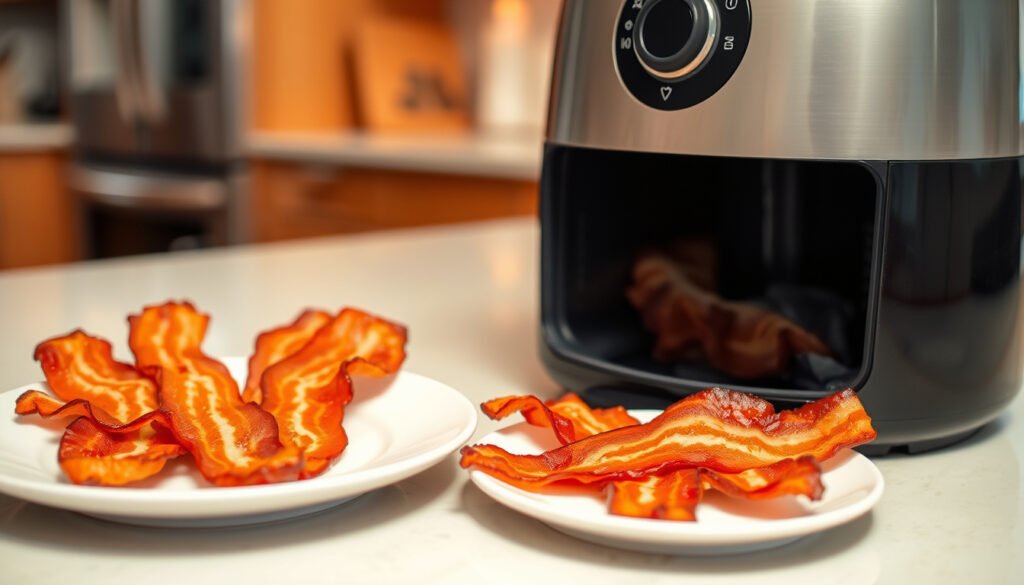
How to Cook Bacon in Air Fryer – Perfect Crispy Results Guide
The air fryer has become one of the most practical tools for cooking bacon at home. Circulating hot air renders fat quickly and evenly, producing strips that range from tender and chewy to deeply crispy—typically in under 15 minutes. The enclosed basket also contains the grease splatter that makes stovetop cooking messy and time-consuming.
Timing and temperature are the two variables that matter most, and both depend on bacon thickness, the specific air fryer model in use, and personal preference for doneness. Getting those two elements right consistently is the core of the method.
The following guide covers standard cooking parameters, preparation steps, troubleshooting common issues, and instructions for frozen or thick-cut variations—drawing from tested methods across multiple published sources.
What Temperature and Time to Cook Bacon in an Air Fryer?
350–400°F (175–200°C)
8–12 minutes
None required
Halfway through
- Preheat the air fryer for 3–5 minutes before adding any bacon.
- Arrange strips in a single layer whenever possible for the most even results.
- Flip bacon halfway through the cooking stage for even crispiness on both sides.
- Use silicone kitchen tongs to handle and separate slices safely inside the basket.
- Cook in multiple batches if the air fryer basket cannot accommodate all strips in a single layer.
- Thick-cut bacon requires a lower temperature and additional cook time compared to regular-cut strips.
- Frozen bacon goes straight into the basket without any defrosting step.
| Bacon Type | Temperature | Time | Notes |
|---|---|---|---|
| Regular cut (fresh) | 350–400°F (175–200°C) | 8–10 min | Flip halfway; single layer preferred |
| Thick cut (fresh) | 360°F (180°C) | 12–15 min | Add 4–5 minutes to standard time |
| Thick cut (alternate method) | 400°F (200°C) | 8–10 min | Flip halfway; time varies by model |
| Frozen (standard method) | 390°F (200°C) | ~8 min total | 4 min thaw + 4 min cook; separate after first stage |
| Frozen (380°F method) | 380°F | 25–28 min total | 10 min initial, separate, flip, then 15–18 min |
| Frozen (two-temperature method) | 210°F → 400°F (100°C → 200°C) | 8 + 12 min | Turn every 2 min during thaw phase |
| Frozen (low-temp thaw) | 300°F thaw, then higher | 8 min thaw + additional | Increase temperature after thaw stage is complete |
Do You Preheat the Air Fryer for Bacon and What Else Matters Before Cooking?
Preheating is consistently recommended. A 3-to-5-minute preheat at the target cooking temperature helps bacon begin rendering fat immediately on contact, which contributes to a crispier result. Sources including Air Frying Foodie and Always Use Butter both include this step as a standard part of their tested methods.
Is Oil Necessary When Cooking Bacon in an Air Fryer?
No added oil is necessary. Bacon contains enough natural fat to cook without any additional lubrication. The fat renders during cooking and drips below the basket, which also prevents strips from sitting in pooled grease throughout the process.
Can You Overlap or Stack Bacon Slices in the Basket?
A single layer is the ideal arrangement. According to The Food Hussy, some overlap is acceptable, particularly at the start when strips are stiff or still frozen. As the bacon cooks and fat renders, slices can be rearranged into a flatter configuration. For frozen bacon, strips are often stuck together at the start—this is normal and expected before the thawing stage separates them.
Silicone kitchen tongs are the recommended tool for separating and flipping bacon slices inside the air fryer basket. Metal utensils risk scratching non-stick basket coatings.
How Many Strips Fit at Once?
Capacity depends on the air fryer model. Smaller baskets may only accommodate 3–4 strips in a single layer. Batch cooking—running two or more rounds—is the practical solution when cooking for multiple people. Overloading the basket significantly extends cook time and reduces crispiness across all strips.
Cooked bacon should be refrigerated and used within 5 days. Unopened raw bacon keeps up to 2 weeks in the refrigerator and up to 8 months in the freezer. Once opened, uncooked bacon lasts about 1 week refrigerated or up to 6 months frozen.
How to Cook Bacon in an Air Fryer Without Smoking?
Smoking typically occurs when rendered fat drips onto a heating element or accumulates at high temperature. The air fryer’s design—where fat falls into a separate drawer beneath the basket—reduces this risk compared to an open pan, but it does not eliminate it entirely under all conditions.
Regular cleaning of the basket and fat drawer between uses is the most effective preventive measure. Fat left from a previous cook can smoke when reheated in a subsequent session, even when fresh bacon is not the source.
How to Get Consistently Crispy Results?
Even crispness depends on a few consistent practices. Flipping the bacon halfway through ensures both sides receive direct airflow exposure. Cooking in a single layer—rather than stacking—allows heat to circulate around each strip. Thicker cuts require lower temperatures and more time; rushing with high heat can leave the interior underdone while the exterior appears finished.
For the crispiest texture, cooking slightly beyond the minimum suggested time while monitoring closely is the approach described across tested sources. The final 1–2 minutes are the most impactful for achieving a distinct snap rather than a chewy strip.
Bacon releases significant fat during cooking. Allowing rendered grease to cool before removing and discarding reduces spill risk. Always clean the basket and fat drawer after each bacon cook to prevent smoking in future sessions.
How to Cook Frozen or Thick-Cut Bacon in an Air Fryer?
Both frozen and thick-cut bacon are well-suited to the air fryer, but each requires specific adjustments to the standard approach. For a detailed walkthrough of the frozen method, see cooking frozen bacon in air fryer.
Frozen Bacon: The Two-Stage Approach
Frozen bacon does not need to be defrosted before cooking. The most widely documented approach uses two stages: a thawing phase followed by a crisping phase. The standard method outlined by Baked Bree involves preheating to 390°F (200°C), cooking the frozen bacon for 4 minutes to begin thawing, separating the slices with tongs, then cooking for a further 4 minutes—flipping once halfway through that second stage.
Alternatives documented by tested sources include a 380°F method where bacon cooks for 10 minutes, is then separated into a single layer, flipped, and cooked an additional 15–18 minutes. A two-temperature method tested by Recipe This starts at 210°F (100°C) for 8 minutes of thawing with turns every 2 minutes, then continues at 400°F (200°C) for 12 minutes of crisping. The wide variation in timing across methods reflects the significant differences between air fryer brands and models.
Thick-Cut Bacon: Lower Heat, Longer Time
Thick-cut bacon benefits from a reduced temperature to allow the interior to cook through before the exterior over-browns. Lowering the temperature to 360°F (180°C) and adding 4–5 minutes to the standard cook time is one established approach. A separate recipe for a perfect crispy air fryer thick cut bacon recipe suggests preheating to 400°F (200°C) and cooking for 8–10 minutes with a halfway flip, noting that actual cook time varies by air fryer model and specific bacon thickness.
What Does the Air Fryer Bacon Process Look Like Step by Step?
- Preheat — Set the air fryer to the target temperature (390°F / 200°C for standard fresh bacon; 360°F / 180°C for thick-cut) and run for 3–5 minutes before loading the basket.
- Load the basket — Place bacon strips in the basket. A single layer is ideal. For frozen bacon, overlapping at the start is unavoidable and acceptable.
- Initial cook — For fresh bacon, cook for 4–6 minutes. For frozen bacon, cook for approximately 4 minutes to begin the thaw.
- Separate the slices — Using silicone tongs, separate any strips that are stuck together and rearrange into as flat a layer as possible.
- Flip — Turn each strip to expose the opposite side to direct airflow.
- Final cook — Continue cooking for 4–6 more minutes for fresh bacon, or longer for thick-cut or frozen variations, checking progress in the final minutes.
- Drain and serve — Remove strips with tongs and rest briefly on a paper towel to absorb excess rendered fat before serving or storing.
What Is Consistent About Air Fryer Bacon—and What Still Varies?
| What Is Established | What Remains Variable |
|---|---|
| Preheating for 3–5 minutes is recommended across all reviewed sources. | Exact cook times differ meaningfully between air fryer brands and models. |
| No oil is needed; bacon fat renders sufficiently on its own. | Optimal temperature depends on personal crispness preference and bacon thickness. |
| Flipping halfway through improves even browning on both sides. | Whether slight overlap or strict single-layer placement produces better results depends on basket geometry. |
| Frozen bacon can be cooked directly without defrosting. | The preferred frozen method—standard two-stage, 380°F, two-temperature, or low-temp thaw—varies by tester and equipment. |
| Thick-cut bacon requires lower temperature and additional time. | The precise extra minutes for thick-cut strips depend on specific thickness and the air fryer model used. |
| Cooked bacon should be refrigerated and consumed within 5 days. | Smoking behavior varies with model design, fat accumulation level, and basket cleanliness. |
Why the Air Fryer Works Well for Bacon
The air fryer’s enclosed basket and high-velocity circulation provide a contained environment for a food that releases significant fat during cooking. Grease drips into the tray below rather than pooling around the strips—a built-in advantage over pan frying, where bacon can sit in rendered fat for the entire cook.
The method also reduces hands-on time. There is no need to stand at a stovetop managing splatter. Setting a timer, flipping once, and returning to a finished batch is the practical routine described across all tested sources reviewed here.
For meal prep, the air fryer handles multiple rounds without requiring temperature adjustments between batches. Cooked bacon keeps well for up to 5 days under refrigeration, making it practical for preparing portions in advance. For additional recipe ideas built around air fryer bacon, Food Network’s air fryer bacon guide offers further context on serving applications.
What Tested Sources Say About Cooking Bacon in an Air Fryer
“You don’t need to defrost bacon before cooking—air fryers can cook it directly from frozen.”
Air Fryer Yum
“Cooking times vary significantly with your air fryer model.”
Always Use Butter
“For thick cut bacon, lower the temperature to 360°F (180°C) and add 4–5 minutes to the cook time.”
Always Use Butter
Multiple independent recipe sources have tested frozen bacon using different temperature approaches and confirm that a two-phase process—thaw then crisp—produces consistent results regardless of the specific temperatures used in each phase. Cooking times in the final crisping stage can be adjusted based on how the bacon looks at the halfway flip, making that check a reliable calibration point regardless of the method chosen.
The Core Takeaway for Anyone Starting Out
Air fryer bacon is a reliable, low-mess method that works for fresh, frozen, and thick-cut strips alike. A temperature range of 350–400°F (175–200°C), a 3-to-5-minute preheat, and a halfway flip are the constants across every tested approach. Everything else—exact timing, batch size, and preferred temperature—adjusts to the specific air fryer model and individual taste. For those working with frozen strips, a step-by-step guide to cooking frozen bacon in air fryer provides a proven two-stage method as a reliable starting point.
Frequently Asked Questions
Do you need to add oil when cooking bacon in an air fryer?
No. Bacon contains enough natural fat that no added oil is required. The fat renders during cooking and drips below the basket, keeping strips from sitting in pooled grease. Adding oil would only increase the overall fat content without improving results.
Can you stack bacon slices in an air fryer?
Stacking is not recommended for the full cook. Some overlap is acceptable at the start—especially with frozen strips—but slices should be separated into as flat a layer as possible once the bacon has softened enough to rearrange. Stacked strips cook unevenly.
How do you get crispy bacon in an air fryer?
Cook in a single layer, flip halfway through, and preheat before adding bacon. Extending the cook time slightly beyond the minimum—while monitoring the last 1–2 minutes closely—produces crispier results. Thicker cuts need lower temperatures to crisp through evenly without burning the exterior.
What is the best air fryer for cooking bacon?
No single model is identified as definitively best across the sources reviewed. Cook times vary significantly by brand and model, so some adjustment is expected with any equipment. Basket size is a practical factor—larger baskets accommodate more strips per batch.
How long does cooked air fryer bacon keep in the refrigerator?
Cooked bacon should be refrigerated and consumed within 5 days. Unopened raw bacon keeps up to 2 weeks refrigerated. Once a package is opened, uncooked bacon lasts approximately 1 week in the refrigerator or up to 6 months in the freezer.
How does cooking frozen bacon in an air fryer differ from cooking fresh bacon?
Frozen bacon requires a two-stage process—a thawing phase to separate stuck strips, followed by a crisping phase. Total cook time is longer than for fresh bacon. Strips begin in a stuck block that gradually separates as heat penetrates during the first stage.
Does the air fryer model affect bacon cook time?
Yes, significantly. Cook times vary between brands and models due to differences in airflow, basket size, and heating element placement. The halfway flip and a visual check near the end of the suggested time range are the most reliable ways to calibrate results for any specific unit.
More related posts
 Sarah Keyworth – Comedian, Pronouns, Partner and Tour Dates
 Caught Stealing (2025) – Cast, Plot and Everything You Need to Know
 English to Hindi Translation – Best Free Apps and Guides
 Keys Cut Near Me – Open Now, Prices & Timpson Guide
 Ben Nevis Mountain – Height, Dangers and Complete Climbing Guide
 Mt Fuji – Height, Eruption History and Climbing Guide
 Translate English to Somali – Best Free Tools and Apps
 Adolescence How Many Episodes – Season 1 Count and Runtimes