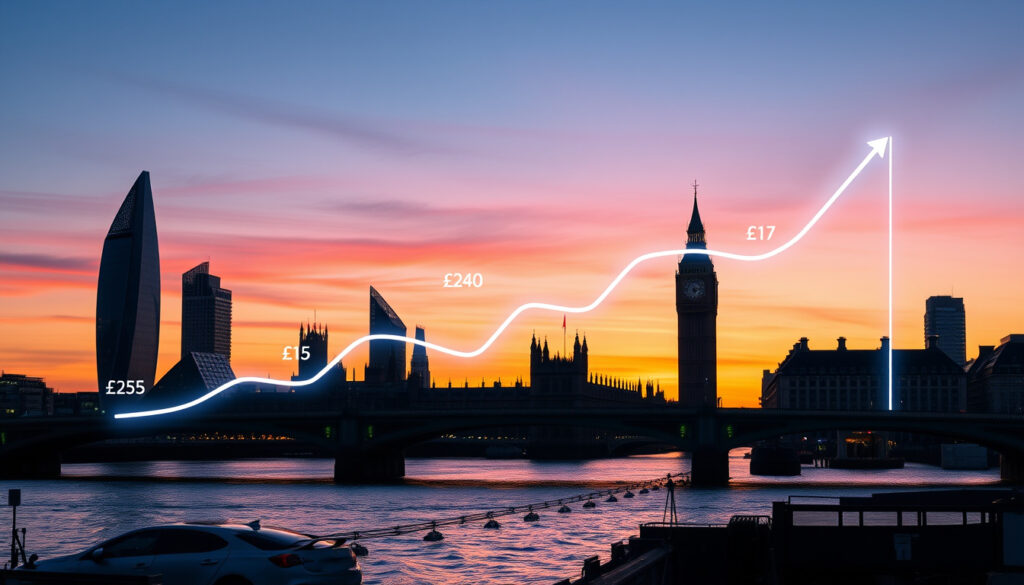
UK Interest Rate Forecast – What to Expect 2025-2030
The Bank of England base rate currently stands at 3.75%, marking a decisive shift in the UK’s monetary policy landscape after a prolonged tightening cycle. With inflation proving stickier than anticipated and geopolitical tensions reshaping global energy markets, the trajectory of UK interest rates over the coming years has become a central concern for homeowners, investors, and businesses alike. This analysis examines the latest forecasts across short, medium, and long-term horizons, drawing on projections from leading economic research firms, the Bank of England’s own communications, and financial market data.
Between August 2024 and December 2025, the Monetary Policy Committee implemented six consecutive rate cuts, reducing the base rate by 25 basis points at each meeting. This aggressive easing cycle brought borrowing costs down from a recent peak of 5.25% to the current 3.75%. However, the pace of reduction has recently stalled, with markets now pricing in a prolonged period of stability rather than the further cuts once expected for early 2026.
What is the UK interest rate forecast for the next 5 years?
Five-year forecasts reveal substantial divergence among analysts, reflecting genuine uncertainty about inflation trajectories, geopolitical developments, and the broader global growth outlook. The following grid synthesises current consensus views across different time horizons.
Key insights emerging from cross-referencing multiple forecast sources include:
- The Bank of England is expected to hold rates steady through much of 2026, abandoning earlier expectations of cuts in the first half of the year
- The conflict in the Middle East has disrupted energy supply chains, pushing inflation forecasts higher than pre-crisis projections
- UK 2-year bond yields have risen to 4.129%, up from 3.52% before the geopolitical escalation, signalling tighter financial conditions ahead
- Oxford Economics projects no rate reductions until at least the third quarter of 2027 under its conservative scenario
- Trading Economics forecasts the base rate trending toward 3.50% in 2027 and 3.00% in 2028 under a moderate scenario
- Mortgage rates are reverting toward the 5% mark for purchase loans, with 10-year fixed products now ranging between 4.50% and 5.75%
- The primary driver of uncertainty remains energy prices and their pass-through to consumer price inflation
| Year | Conservative Forecast | Moderate Forecast | Source |
|---|---|---|---|
| 2026 | 4.00% | 3.75% | Tempo Money; Trading Economics |
| 2027 | 3.50%–4.00% | 3.50% | Oxford Economics; Trading Economics |
| 2028 | 3.00% | 3.00% | Trading Economics |
| 2029 | 2.50% | 3.25% | Oxford Economics; Santander |
What is the UK interest rate forecast for 2026 and 2027?
The 2026–2027 period represents a critical juncture for UK monetary policy. The Bank of England had previously signalled confidence that inflation would return to its 2% target by spring 2026, which would have justified continued rate reductions. Those expectations have now been revised following the surge in global energy prices triggered by the Middle East conflict.
Base rate trajectory for 2026
Under the revised outlook, markets now anticipate the base rate remaining at or near 3.75% for the foreseeable future, with some analysts suggesting rates could edge higher toward 4.00% by year-end if inflationary pressures persist. The Monetary Policy Committee has emphasised its data-dependent approach, meaning decisions will hinge on monthly inflation readings and labour market indicators.
Projected mortgage rate ranges for 2026
Fixed mortgage rates have already begun adjusting upward in response to rising swap rates, which lenders use as pricing benchmarks. Projected ranges for 2026 reflect this heightened uncertainty:
- 2-year fixed rate mortgages: 3.50% – 4.50%
- 3-year fixed rate mortgages: 3.75% – 5.00%
- 5-year fixed rate mortgages: 4.00% – 5.25%
- 10-year fixed rate mortgages: 4.50% – 5.75%
These ranges represent a notable increase from the sub-4% rates briefly available to some borrowers in late 2024. First-time buyers and those remortgaging should factor these higher borrowing costs into their financial planning.
The relationship between the Bank of England base rate and actual mortgage rates is indirect but meaningful. Lenders set their own prices based on swap rates and competitive pressures, meaning borrowers may find significant variation between lenders at any given time. Comparing offers across multiple providers remains advisable.
Oxford Economics scenarios for 2027
Oxford Economics provides two contrasting scenarios for 2027. Under the conservative projection, no rate cuts occur until at least the third quarter, with the base rate held at elevated levels well into the year. The optimistic scenario envisions rates eventually falling to 2.5% by late 2027, remaining around that level through 2028 and 2029. The determining factor in which scenario materialises will be the path of services inflation and wage growth in the UK economy.
What are the short-term UK interest rate forecasts for the next 2–3 years?
Short-term forecasts focus on the 2025–2027 window, where data quality is highest and analyst consensus is relatively strong. The immediate outlook has shifted markedly since the turn of the year, with earlier predictions of continued rate cuts now giving way to expectations of an extended pause.
Recent historical context
The cutting cycle from August 2024 to December 2025 delivered six reductions of 25 basis points each, the most aggressive easing sequence since the immediate post-pandemic period. This brought the base rate from 5.25% to 3.75%, a level not seen since early 2022. The rationale behind these cuts was the steady decline in inflation from its 2022 peak above 11% toward the Bank’s 2% target.
Factors shaping near-term expectations
Three principal factors are influencing near-term rate expectations. First, energy price shocks from geopolitical disruption have complicated the inflation outlook, with oil and gas costs rising sharply in recent months. Second, wage growth in the services sector remains elevated, supporting continued inflationary pressure in consumer-facing industries. Third, global growth has proven more resilient than feared, reducing the urgency for aggressive monetary easing.
The Bank of England’s next scheduled rate decision dates are published on its official website. Those tracking potential rate changes should monitor the quarterly Inflation Report and monthly consumer price index releases for the clearest signals on future policy direction.
Conservative versus moderate scenarios
Under the conservative scenario favoured by Oxford Economics, the base rate holds steady through 2026 and enters a gradual easing cycle only in the third quarter of 2027. This projection assumes inflation remains above target through mid-2027 and that services sector price growth proves sticky. The moderate scenario from Trading Economics is more optimistic, forecasting movement toward 3.50% in 2027 as inflation finally anchors near 2%.
What do long-term forecasts say for UK interest rates to 2030?
Longer-term forecasts become increasingly speculative beyond the five-year horizon, as economic structure, productivity growth, and global trade patterns can shift in ways that render near-term projections unreliable. Nevertheless, several established forecasting frameworks provide indicative ranges for the 2028–2030 period.
Medium-term equilibrium rates
Santander’s research suggests UK rates will stabilise in a range between 3% and 4% for the foreseeable future, implying a gradual convergence toward a new equilibrium following the post-pandemic rate cycle. This range sits below the 5%+ levels seen during the 2022–2023 tightening but above the near-zero rates that prevailed during the 2009–2016 era.
Structural factors affecting long-term rates
Several structural factors may influence where long-term rates settle. Demographic shifts, including an ageing population, tend to reduce aggregate demand and exert downward pressure on real interest rates. Productivity growth trends will determine whether the UK can achieve sustained expansion without generating inflation. Global trade relationships and energy policy will also shape the economic conditions within which monetary policy operates.
Long-term interest rate projections carry significantly higher uncertainty than short-term forecasts. Economic shocks, policy regime changes, and structural transformations in the global economy can all cause actual outcomes to diverge substantially from current consensus estimates.
How have UK interest rates changed over time?
Understanding the historical context of Bank of England rate decisions helps illuminate how unusual the current cycle has been. The following timeline traces recent rate movements and the policy rationale behind them.
- August 2024: Bank of England begins cutting cycle, reducing base rate from 5.25% to 5.00%
- November 2024: Second cut brings rate to 4.75% as inflation declines toward target
- February 2025: Third reduction to 4.50% following weaker-than-expected jobs data
- May 2025: Fourth cut to 4.25% amid signs of economic slowing
- August 2025: Fifth reduction to 4.00% as inflation approaches 2%
- December 2025: Final cut of the cycle brings rate to 3.75%
- Early 2026: Middle East conflict escalates, energy prices surge, rate cut expectations stall
- 2026–2027: Base rate expected to hold steady pending inflation resolution
What is certain and uncertain about UK interest rate forecasts?
Assessing the reliability of different forecasts requires distinguishing between what analysts consider established fact and what remains genuinely contested. The following comparison highlights the key areas of consensus and uncertainty.
| Established Information | Uncertain or Contested |
|---|---|
| Current base rate: 3.75% | Exact timing of next rate move |
| Six cuts implemented Aug 2024–Dec 2025 | Whether rates rise or fall in 2026 |
| Middle East conflict affecting energy prices | Magnitude of inflation impact |
| Bank of England targeting 2% inflation | Speed of return to target inflation |
| Rate decisions are data-dependent | Labour market resilience under higher rates |
| Swap rates influencing mortgage pricing | Final equilibrium rate level (2028+) |
How do UK interest rates connect to inflation and economic growth?
The Bank of England operates a symmetric inflation target of 2%, meaning it will raise rates to cool excessive price growth and lower them when inflation falls below target. This mandate links interest rate policy directly to inflation outcomes, which in turn depend on energy prices, wage growth, and global trade conditions.
The current complication is that geopolitical disruption has pushed energy costs higher at precisely the moment when the Bank was approaching its inflation goal. If energy-induced inflation proves transitory, rates may remain on hold without requiring further tightening. If it proves persistent, with second-round effects on services and wages, the Bank may need to reverse course and raise rates despite the economic costs.
Economic growth forecasts from the Bank of England suggest the UK economy has proven more resilient than many observers expected during the post-pandemic adjustment. This resilience reduces the urgency for aggressive rate cuts but also means demand-side inflationary pressures have not fully dissipated.
Readers seeking deeper background on inflation trends may find it useful to examine historical consumer price index data alongside the forecast ranges presented here. Understanding how past inflation episodes resolved can provide useful perspective on the likely path of future rate decisions.
What do sources and experts say about UK interest rate forecasts?
Multiple authoritative sources inform the projections presented in this analysis. The Bank of England’s own communications, including its quarterly Inflation Report and regular rate decision statements, provide the official foundation for understanding monetary policy intentions.
“The base rate will not be cut until at least the third quarter of 2027, with rates held through the remainder of 2026 and well into 2027.”
— Oxford Economics forecast, cited by Money Week and HOA
“The base rate will trend around 3.50% in 2027 and 3.00% in 2028.”
— Trading Economics econometric model
Financial market data from Trading Economics offers real-time tracking of bond yields and market-implied rate expectations, providing a complementary perspective to formal analyst forecasts. Mortgage industry sources including Mortgageable and HOA offer practical guidance on how rate changes translate into actual borrowing costs for consumers.
Summary
The UK interest rate landscape has shifted considerably since the aggressive cutting cycle of 2024–2025. With the base rate now at 3.75% and the inflation outlook complicated by geopolitical energy shocks, the market expects rates to hold steady through much of 2026 before potentially resuming a gradual easing trajectory. Forecasts for 2027 and beyond span a wide range, from conservative projections of rates held above 4% through to optimistic scenarios envisioning a return to 2.5%. The primary uncertainty remains the path of energy prices and their transmission into consumer inflation, which will determine whether the Bank of England can sustain its current pause or must consider further action. Those with mortgage or savings decisions to make should monitor monthly inflation releases and Bank of England communications closely while maintaining flexibility in their financial planning.
For additional context on related financial topics, readers may explore the High Interest Savings Account Rates guide, which examines how current rate conditions affect returns on cash deposits.
Frequently Asked Questions
What is the current Bank of England base rate?
The Bank of England base rate currently stands at 3.75% as of December 2025. The rate was reduced six times between August 2024 and December 2025, each reduction being 25 basis points.
When might the Bank of England cut rates again?
Market expectations have shifted away from early 2026 cuts following the surge in global energy prices triggered by the Middle East conflict. Oxford Economics projects no cuts until at least the third quarter of 2027 under its conservative scenario.
What will mortgage rates be in 2026?
Forecast mortgage rates for 2026 span 3.50%–4.50% for 2-year fixed products, 3.75%–5.00% for 3-year fixed, 4.00%–5.25% for 5-year fixed, and 4.50%–5.75% for 10-year fixed products.
How reliable are long-term interest rate forecasts?
Long-term forecasts beyond five years carry substantial uncertainty. Structural factors including demographics, productivity, and global trade patterns can shift in ways that cause actual outcomes to diverge from current projections.
What drives uncertainty in UK interest rate forecasts?
The primary uncertainty is the path of energy prices and their pass-through to consumer inflation. The Bank of England’s own communications acknowledge that geopolitical developments can rapidly alter the inflation outlook in either direction.
How do UK interest rates affect savings accounts?
While base rate changes influence savings rates, individual providers set their own pricing based on competitive pressures and funding needs. Comparing accounts across multiple providers remains the most reliable way to secure competitive returns.
More related posts
 Sophie Ellis – Biography, Songs, Husband, and Net Worth
 Tammy Abraham – Bio, Stats, Injury Update & Personal Life
 Mike Tyson – Age, Net Worth, and Biography in 2025
 How to Get Rid of Gum Disease – Reversal, Care and Risks
 Pest Control Near Me – Compare Prices and Council Services
 Valentino Donna Born In Roma – Notes, Longevity, Prices
 Christopher Reeve – Tragic Accident, Cause of Death, and Lasting Legacy
 Charlie Dimmock – Biography, Age, Children and Latest News 2025