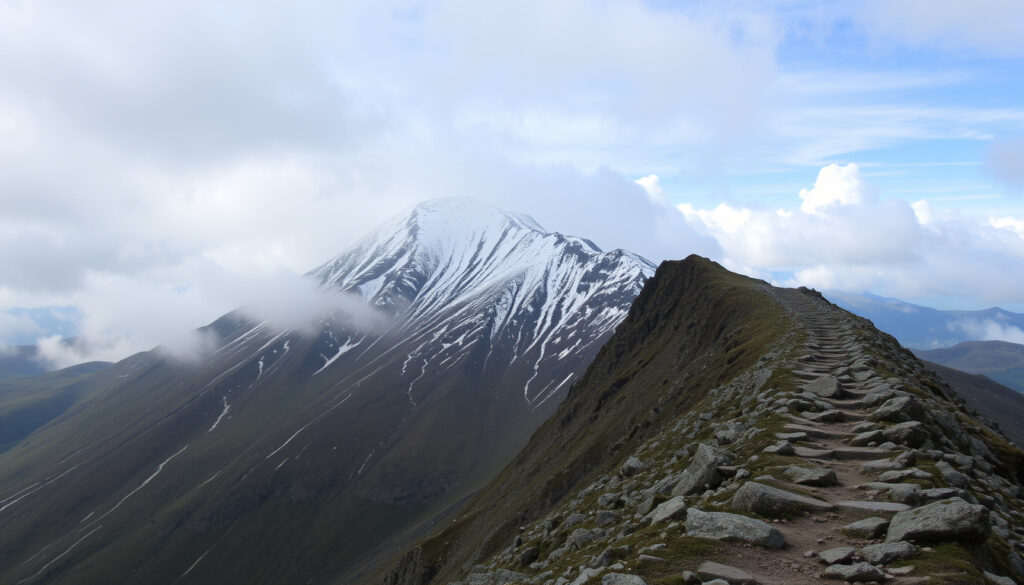
Ben Nevis Mountain – Height, Dangers and Complete Climbing Guide
Ben Nevis stands as the highest mountain in the United Kingdom, a peak that draws more than 150,000 climbers each year. But its modest height of 1,345 metres belies a dangerous reputation. The mountain has claimed over 100 lives since record-keeping began in 1849, with an annual fatality rate that some sources say exceeds that of Mount Everest.
Located 7 kilometres southeast of Fort William in the Scottish Highlands, Ben Nevis sits at the western end of the Grampian Mountains. Its summit, marked by grid reference NN 166 712, is the highest land in any direction for 739 kilometres. The mountain is an extinct volcano, its present form shaped by millions of years of erosion.
Despite its accessibility from the nearby town of Fort William, Ben Nevis is not a gentle hill. It is a serious mountain that demands preparation, respect, and caution regardless of the route or season. The following sections break down the key facts, dangers, and practical advice for anyone planning to visit.
What is the height of Ben Nevis?
The official height of Ben Nevis was remeasured in 2016 by the Ordnance Survey as 1,344.527 metres (4,413 feet). In most sources, including tourist guides and Wikipedia, this is rounded to 1,345 metres. The summit is the highest point in the British Isles.
1,345 m (4,413 ft) – highest in the British Isles
Grampian Mountains, Scotland, near Fort William
High – weather changes rapidly, many fatalities
7–9 hours via Mountain Path (summer)
Key insights
- Ben Nevis is the tallest mountain in the UK and British Isles, rising 1,345 m above sea level.
- Over 150,000 people climb Ben Nevis annually, but it is a serious undertaking with significant risks.
- The mountain’s weather is notoriously unpredictable and can turn deadly even in summer.
- Fatalities occur regularly – dozens recorded over the decades, often due to slips, exposure, or poor preparation.
- The summit is cloud-covered nearly 80% of the time in winter and 50% in summer, limiting visibility.
- Annual rainfall at the summit is about 4,350 mm, more than double that of Fort William.
- Ben Nevis is an extinct volcano, formed from a collapsed granite intrusion around 400 million years ago.
Snapshot facts
| Feature | Value |
|---|---|
| Height (metres) | 1,345 m |
| Height (feet) | 4,413 ft |
| Location | Grampian Mountains, Lochaber, Highland, Scotland |
| Closest settlement | Fort William |
| First recorded ascent | 1771 (by James Robertson) |
| First recorded ascent (tourist) | 1774 (by John Williams) |
| Mountain type | Extinct volcano (igneous pluton, eroded) |
| Mountain range | Grampian Mountains |
| Annual climbers | ~150,000 |
The closest settlement to Ben Nevis is Fort William, located about 7 kilometres northwest of the summit. The mountain rises from the western end of the Grampian range, in the Lochaber area of the Scottish Highlands. For context, you can also read about Mt Fuji – Height, Eruption History and Climbing Guide, another iconic peak with a rich climbing tradition.
Why is Ben Nevis so dangerous?
Ben Nevis kills more climbers per year than Everest, despite being less than half the height of the world’s tallest mountain. Over 100 fatalities have been recorded since 1849, and some sources suggest the figure may exceed 150. The most common cause of death is falls, often from the sheer northeast face, due to disorientation, equipment failure, or poor weather. Avalanches are a constant threat, especially on steeper routes like the North Face; a 2019 avalanche killed three people. In 2024 alone, mountain rescue teams were called out 165 times.
How many deaths occur on Ben Nevis?
The exact number of deaths varies by year and no single authoritative count exists. Estimates range from 2 to 5 fatalities per year on average. Most deaths result from slips and falls, often on the popular Mountain Track, where the loose scree and sudden weather changes catch walkers off guard. Unprepared ascents, even on the easy “Mountain Track” (also called the Pony Track), are highly discouraged due to volatile weather.
The Mountain Track is the most popular route up Ben Nevis, a 7 km walk with 1,340 m of climb. It is often described as “easy,” but that label is misleading. The track is slippery, steep in sections, and exposed to the full force of the mountain’s weather. Most fatalities occur on this route because walkers underestimate the conditions.
What is the worst time to climb Ben Nevis?
There is no single answer that applies to all climbers. The worst time depends on individual experience, fitness, and equipment. However, the winter months — November through January — bring the most severe conditions: fog is present 80% of the time, the summit is cloud-covered almost constantly, and the mountain experiences an average of 261 full gales per year. Even in summer, conditions can deteriorate rapidly. The best approach is to check mountain-specific forecasts from multiple sources, including the Met Office – Ben Nevis forecast, and to avoid climbing in heavy rain, high winds, or freezing temperatures.
Climbing routes and their dangers
Four main categories of routes lead to the summit, each with a different level of difficulty and risk. The table below summarises the key options.
| Route | Difficulty | Notes |
|---|---|---|
| Mountain Track (Pony Track) | Easy | Most popular; 7 km walk, 1,340 m climb; still dangerous due to weather |
| North Face | Extreme | Technical rock/ice climbing; high risk of avalanches and falls |
| Four Ridges | Moderate–Hard | For experienced climbers; includes serious technical sections |
| Other routes | Varies | Hundreds of routes exist, ranging from easy to extremely challenging |
Waterproofs, warm clothing, sturdy boots, map and compass, headlamp, first aid kit, and a fully charged mobile phone. Navigation is notoriously difficult; hill fog can roll in instantly, causing disorientation. Always inform someone of your route and carry a flexible timetable. Avoid solo climbs.
What is the climate like on Ben Nevis?
Ben Nevis has a highland tundra climate, classified as Köppen ET. The summit is cloud-covered nearly 80% of the time in winter and 50% in summer. Annual rainfall reaches about 4,350 mm at the summit — more than double the 2,050 mm recorded in Fort William and seven times the 600 mm typical of London. The mountain experiences 261 full gales per year on average, and fog is present 80% of the time between November and January, dropping to 55% from May to June.
Weather changes alarmingly rapidly due to Atlantic storm systems. Temperatures can drop several degrees below zero even on warm days in Fort William. This means that climbers can experience summer-like conditions at the base and full winter conditions at the summit within the same hour. The Ben Nevis Weather Station (historic data) provides detailed records of these extreme conditions.
The combination of Atlantic storms, high altitude, and the mountain’s isolated position means that weather can change from clear to deadly in minutes. Whiteouts are common, and the summit can be shrouded in fog even when the base is sunny. Climbers are advised to treat every forecast as provisional and to be prepared for the worst.
Because of the persistent cloud cover, some walkers say you may need to climb Ben Nevis five or six times to get a clear view from the top. The mountain’s weather is a defining feature and a major factor in its danger.
When was Ben Nevis first climbed?
The first recorded ascent of Ben Nevis was made in 1771 by botanist James Robertson. A later tourist ascent was documented in 1774 by John Williams. Since then, the mountain has seen a rich history of exploration, scientific study, and climbing incidents. The timeline below highlights the key events.
- ~400 million years ago — Geological formation: Ben Nevis formed from a collapsed volcano, granite intrusion.
- 1771 — First recorded ascent by botanist James Robertson.
- 1774 — First tourist ascent by John Williams.
- 1883 — First meteorological observatory built on summit (operated until 1904).
- Late 20th century — Increase in popularity, leading to more fatalities and safety campaigns.
- 2020s — Ongoing incidents; annual death toll averages 2–3, with many rescues.
The mountain’s history is also one of rescue and remembrance. Organisations like Scottish Mountain Rescue play a critical role in keeping climbers safe, responding to dozens of callouts each year.
What is known and what remains uncertain about Ben Nevis?
While many facts about Ben Nevis are well established, some details remain unclear or vary between sources. The table below separates what is certain from what is less certain.
| Established information | Information that remains unclear |
|---|---|
| Height of Ben Nevis is 1,344.527 m (based on 2016 survey) – widely accepted as 1,345 m. | Exact death toll varies by year; no single authoritative count – estimates range from 2–5 fatalities per year. |
| Location: Grampian Mountains, Scotland. | Weather conditions are highly unpredictable; forecasts can change rapidly. |
| Ben Nevis is an extinct volcano. | The “worst time to climb” depends on individual experience and conditions; no single answer applies to all. |
| Closest settlement is Fort William. | Some sources suggest the death toll may exceed 150, but this is not universally confirmed. |
What makes Ben Nevis significant beyond its height?
Ben Nevis is the highest of the British peaks, but its significance extends beyond elevation. It is an iconic mountain for British mountaineering, featured in literature, film, and as a major tourist attraction. Its height relative to sea level is modest compared to the Alps, but its latitude and maritime climate create severe weather that rivals much higher mountains.
The mountain sits at the western end of the Grampian Mountains, and its nearest neighbour in terms of height is Ben Macdui, the second-highest peak in the UK. However, the specific dangers of Ben Nevis — rapid weather changes, loose scree, cornices, poor visibility, and the false sense of security given by the popular Tourist Path — make it a unique challenge. Most deaths occur from slips, falls, and exposure, often on routes that appear straightforward.
Culturally, Ben Nevis holds a special place in the outdoor community. It is a rite of passage for many hikers, and its summit observatory, which operated from 1883 to 1904, provided some of the earliest continuous weather records from a high-altitude site in Britain. For those interested in endurance challenges, the physical demands of climbing Ben Nevis can be compared to training for a long-distance event — see How Many Km Is a Half Marathon – Exact Distance, Times and Training Tips for a related perspective on preparation and pacing.
What do official sources say about Ben Nevis?
Several authoritative sources provide reliable information about the mountain. The quotes below reflect the consensus among official guides and reference works.
“Ben Nevis is the highest mountain in Scotland, the United Kingdom, and the British Isles.”
“Discover Ben Nevis, Scotland’s iconic mountain. 20 m above sea level. The journey takes approximately 12-15 minutes, 7 – 9 hours.”
“Ben Nevis is the highest mountain in Britain. It is a tough and strenuous walk.”
These sources are widely cited and provide a foundation of reliable information. For current conditions, the Met Office and Scottish Mountain Rescue offer the most up-to-date guidance.
What should you remember before climbing Ben Nevis?
Ben Nevis is a serious mountain that demands preparation, respect, and caution. Its height is modest, but its weather is extreme and its terrain is unforgiving. Check the latest forecast from multiple sources, pack appropriate gear, inform someone of your route, and consider joining a guided group if you are inexperienced. The mountain will still be there tomorrow — there is no shame in turning back if conditions are not right.
For further reading, explore the Mt Fuji – Height, Eruption History and Climbing Guide for a comparison with another iconic world peak, or review the How Many Km Is a Half Marathon – Exact Distance, Times and Training Tips article for insights on physical endurance and preparation.
Frequently asked questions about Ben Nevis
How long does it take to climb Ben Nevis?
The Mountain Path (Tourist Route) typically takes 7–9 hours round trip. Other routes are longer and more technical.
Is Ben Nevis suitable for beginners?
With proper preparation, beginners can attempt the Mountain Path in good weather, but it is a strenuous walk with real risks. Guided climbs are recommended.
What should I bring to climb Ben Nevis?
Waterproof clothing, sturdy boots, map, compass, food, water, headtorch, first aid kit, and a fully charged phone. Always check conditions.
What is the best time of year to climb Ben Nevis?
June to September offers the most stable weather, but conditions can still deteriorate quickly. Avoid winter unless experienced with crampons and ice axe.
How many people die on Ben Nevis each year?
Estimates range from 2 to 5 fatalities per year. Over 100 deaths have been recorded since 1849, with some sources suggesting 150 or more.
Is Ben Nevis harder to climb than Everest?
In terms of altitude, no. But Ben Nevis kills more climbers per year than Everest due to its volatile weather, frequent whiteouts, and the false sense of security its moderate height gives.
What is the closest town to Ben Nevis?
Fort William, located about 7 km northwest of the summit, is the nearest settlement and the main base for climbers.
Can you climb Ben Nevis in winter?
Yes, but only with proper winter equipment including crampons and ice axe, and with experience in snow and ice conditions. Most fatalities occur in winter.
What is the main cause of death on Ben Nevis?
Falls, often from the northeast face, due to disorientation, equipment failure, or poor weather. Avalanches also pose a significant threat.
More related posts
 Mike Tyson – Age, Net Worth, and Biography in 2025
 Oasis Don’t Look Back in Anger Lyrics – Full Text, Meaning & Chords
 New Rules for Older Drivers – Mandatory Eye Tests for Over 70s
 How Many Grams in a Pound – Exact NIST Standards and Troy Differences
 Pete Davidson – Biography, Relationships, Net Worth and More
 Lady Gaga – real name, age, husband and biggest songs 2025
 Emperor Penguin – Facts, Habitat and Endangered Status 2026
 George Osborne – Career, Net Worth, Family and Current Roles