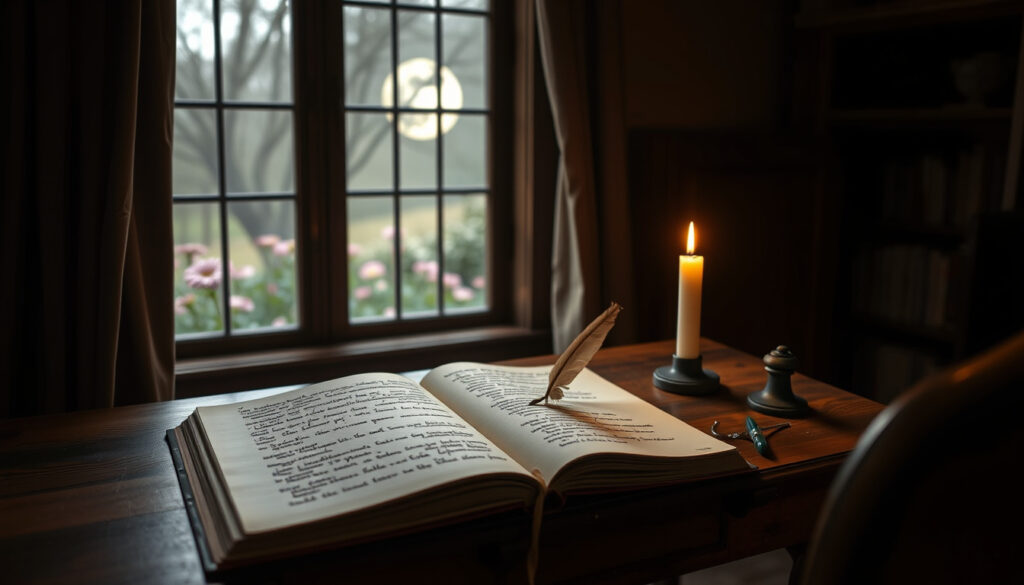
Emily Dickinson – Life, Poems, Death and Lasting Legacy
Emily Dickinson, born in Amherst, Massachusetts, in 1830, is now regarded as one of the most important figures in 19th-century American poetry. During her lifetime, she published fewer than a dozen of the nearly 1,800 poems she wrote. Her reclusive lifestyle, distinctive white dress, and innovative use of language have made her a subject of enduring fascination.
Dickinson’s work was largely unknown until after her death in 1886. Her sister Lavinia discovered hand-sewn booklets, called fascicles, filled with poems that would eventually reshape the literary landscape. Today, Dickinson is celebrated for her compressed, slant-rhymed verses that explore themes of death, immortality, nature, and love.
Her life raises many questions: Why did she withdraw from society? Who did she love? How did she die? This guide draws on authoritative sources to separate established facts from ongoing scholarly debate.
Who Was Emily Dickinson?
Key Insights
- Emily Dickinson wrote nearly 1,800 poems, but fewer than a dozen were published during her lifetime.
- She lived most of her adult life in self-imposed isolation, rarely leaving her family home.
- Her poetry is known for its unconventional punctuation, slant rhyme, and themes of death, immortality, and nature.
- Speculation about her romantic life (especially with Judge Otis Lord and Susan Gilbert) remains unresolved.
- The exact cause of her death is recorded as Bright’s disease, but some historians suggest other illnesses.
Key Facts About Emily Dickinson
| Fact | Detail |
|---|---|
| Full Name | Emily Elizabeth Dickinson |
| Birth | December 10, 1830, Amherst, MA |
| Death | May 15, 1886, Amherst, MA (age 55) |
| Cause of Death | Bright’s disease (nephritis) — historical consensus |
| Poems Written | ~1,800 |
| First Published Collection | 1890 (posthumous) |
| Marital Status | Never married, no children |
| Education | Mount Holyoke Female Seminary (one year) |
What Are Emily Dickinson’s Most Famous Poems?
Dickinson’s most celebrated poems include “Because I could not stop for Death,” “Hope is the thing with feathers,” and “I’m Nobody! Who are you?” These works exemplify her compressed style and thematic depth. She wrote nearly 1,800 poems in total, according to the Poetry Foundation.
How Many Poems Did She Write?
Scholars count approximately 1,800 poems. Only about ten appeared in print while she was alive. After her death, Lavinia Dickinson discovered the poems in fascicles, which were later published in stages. The first major collection came out in 1890, but a complete and faithful edition was not released until 1955.
What Is Her Poetic Style?
Dickinson’s style is characterized by short lines, compressed language, and slant rhyme. She often used dashes and unconventional capitalization. Her themes frequently touched on nature, mortality, faith, love, and death. The Britannica biography notes her “intensely personal and original” voice.
Dickinson assembled her poems into hand-sewn booklets we now call fascicles. These manuscripts reveal her careful revisions and provide insight into how she organized her work. The Emily Dickinson Museum holds many of these original booklets.
How Did Emily Dickinson Die?
Emily Dickinson died on May 15, 1886, at the age of 55, in her family home in Amherst. Her physician listed the cause as Bright’s disease, a historical term for kidney disease (nephritis). Some later accounts simplify this as heart failure, reflecting differing descriptions over time.
What Was the Exact Cause?
The primary recorded cause is Bright’s disease, according to Wikipedia and Biography.com. However, historians note that the diagnosis was made without modern medical tools, and other conditions—such as hypertension or even mental illness—have been suggested. The uncertainty remains unresolved.
Where Is She Buried?
Dickinson is buried in the West Cemetery in Amherst, Massachusetts, in the family plot. Her grave is a popular site for literary pilgrims.
While Bright’s disease is the official cause of death, no autopsy was performed. Some scholars argue that the symptoms described in letters could also point to hypertension or other chronic conditions. This nuance is often lost in simplified retellings.
Did Emily Dickinson Have a Husband?
Emily Dickinson never married and had no children. But the question of romantic attachments is one of the most debated topics in Dickinson scholarship. The Emily Dickinson Museum notes that her love life remains a major area of study.
Who Were Her Possible Love Interests?
Among the names discussed are Judge Otis Phillips Lord, to whom she wrote affectionate letters suggesting a possible late-life romance. There are also the mysterious “Master” letters addressed to an unidentified recipient. Other candidates include Leonard Humphrey, Benjamin Newton, and her sister-in-law Susan Gilbert. Evidence for each remains circumstantial.
Did She Have Children?
No historical record indicates that Dickinson had children. She lived in her family home with her sister Lavinia and brother Austin.
The Academy of American Poets emphasizes that Dickinson’s inner life is best understood through her poems and letters, which often express longing and passion without revealing concrete details about specific relationships.
What Are the Best Emily Dickinson Books?
For readers seeking a complete collection, the scholarly standard is The Poems of Emily Dickinson: Variorum Edition edited by R. W. Franklin. A more accessible one-volume edition is The Complete Poems of Emily Dickinson, based on the 1955 edition by Thomas H. Johnson.
Several biographies provide context for her life, including Emily Dickinson: A Biography by Alfred Habegger. The Emily Dickinson Archive offers digital access to manuscripts and transcriptions for those who want to explore the primary sources.
Is There a Movie or TV Show About Emily Dickinson?
The most prominent modern adaptation is Apple TV+’s series Dickinson, which premiered in 2019. The show reimagines Dickinson’s life with a contemporary tone, blending historical events with anachronistic dialogue. A feature film, A Quiet Passion (2016), directed by Terence Davies, offers a more traditional biographical drama.
These portrayals have sparked renewed interest in Dickinson’s poetry, especially among younger audiences. The Poetry Foundation notes that such adaptations can lead to increased readership of her original work.
How Old Was Emily Dickinson When She Died?
She died at age 55. The following timeline places key events in her life in sequence.
- — Born on December 10 in Amherst, Massachusetts.
- — Attends Mount Holyoke Female Seminary for one year.
- — Begins writing poems in earnest; increasingly withdraws from social life.
- — Starts assembling poems into fascicles.
- — Writes over 300 poems; year of intense creativity.
- — Deepens reclusiveness; wears only white.
- — Dies on May 15; cause listed as Bright’s disease.
- — First posthumous collection Poems by Emily Dickinson published.
- — Complete poems edited by Thomas H. Johnson published.
- — Apple TV+ series Dickinson premieres.
Why Did Emily Dickinson Wear White?
Dickinson began wearing all white in her later years, and this has become one of her most iconic images. According to the Emily Dickinson Museum, the white dress is an important biographical detail, though its meaning is debated.
The following table separates what is established from what remains unclear.
| Established Information | Information That Remains Unclear |
|---|---|
| Dickinson was born in Amherst, lived there most of her life, and died there. | The exact cause of death (Bright’s disease vs. other conditions) is still discussed. |
| She wrote approximately 1,800 poems, most unpublished until after her death. | Who her romantic partner(s) were is uncertain; evidence for Susan Gilbert and Judge Lord is circumstantial. |
| She never married and had no children. | Whether she was deliberately reclusive or simply introverted is debated. |
| Her death was attributed to Bright’s disease. | Some poems’ dating and order remain uncertain even among scholars. |
What Themes Did Emily Dickinson Write About?
Dickinson’s poetry consistently returns to nature, mortality, faith, love, and death. In the context of 19th-century American literature, she stands apart from contemporaries like Walt Whitman. Her work was considered radical for its unconventional punctuation and syntax.
Her posthumous rise to fame was shaped by editorial choices. Early editors smoothed her dashes and regularized her rhymes, obscuring her originality. It was only with the 1955 variorum edition that readers encountered her poems as she wrote them.
Dickinson’s reclusiveness can be viewed as either a response to societal expectations for women or a deliberate artistic strategy. The Britannica biography notes that she cultivated fewer relationships over time and increasingly stayed home.
What Are the Key Sources and Quotations for Studying Emily Dickinson?
Authoritative sources include the Emily Dickinson Museum, the Poetry Foundation, Britannica, and the Academy of American Poets. The Wikipedia page provides a thorough factual overview. For digital manuscripts, the Emily Dickinson Archive is indispensable.
“Hope is the thing with feathers that perches in the soul – And sings the tune without the words – And never stops – at all”
— Poem #254, Emily Dickinson
“Because I could not stop for Death – He kindly stopped for me –”
— Poem #479, Emily Dickinson
“Tell all the Truth but tell it slant –”
— Poem #1129
What Is Emily Dickinson’s Lasting Legacy?
Emily Dickinson is now considered a central influence on modern poetry. Her formal daring and emotional precision have inspired countless poets. Ongoing scholarly research continues to examine her manuscripts, letters, and possible relationships. For readers wanting to explore further, More poems by Emily Dickinson are available on this site, along with a 19th-century American poetry guide that places her work in historical context.
Frequently Asked Questions About Emily Dickinson
Why did Emily Dickinson wear white?
According to historical accounts, Dickinson began wearing all white in her later years, possibly as a personal choice or to symbolise purity and remove herself from fashion trends. There is no definitive explanation.
Did Emily Dickinson ever leave her house?
After the 1860s, Dickinson rarely left the family Homestead in Amherst. However, she still received visitors and corresponded widely.
What is the most famous Emily Dickinson poem?
Several poems are widely anthologized, including “Because I could not stop for Death,” “Hope is the thing with feathers,” and “I’m Nobody! Who are you?”
How many poems did Emily Dickinson write in total?
She wrote approximately 1,800 poems, collected and published posthumously.
Where can I find the complete works of Emily Dickinson?
The definitive scholarly edition is The Poems of Emily Dickinson: Variorum Edition edited by R.W. Franklin, or you can access the Emily Dickinson Archive online.
What is the Emily Dickinson Archive?
The Emily Dickinson Archive (edickinson.org) is a digital repository of high-resolution images of her manuscripts and transcriptions, provided by Harvard and other institutions.
Are there any communities on Reddit about Emily Dickinson?
Yes, subreddits like r/Poetry and r/EmilyDickinson discuss her work and life. Search “Emily Dickinson Reddit” for ongoing threads.
More related posts
 Wwe Wrestling – 2026 Guide with Champions and Results
 UK Interest Rate Forecast – What to Expect 2025-2030
 Lauren Hemp – Biography, Career and Personal Life Facts
 Black and White Dunks – Sizes, Prices and Availability
 Charlie Dimmock – Biography, Age, Children and Latest News 2025
 Elizabeth Davies – Fitness Coach, Professor, and More
 7 Stages of Grief – Order, Differences and Breakup Insights
 Best Dog Food UK – Top Independent Ratings 2025